
The Red Baron
Yes, he was a real person, and the highest-scoring ace in World War I.

On April 21, 1918, the Red Baron died. I’m posting this only a few days past the 107th anniversary. For those of you who have only seen Snoopy taking off in his doghouse-turned-airplane to do battle with the Red Baron, or maybe the pizza-eaters (he was blond and clean-shaven, completely opposite from the pizza icon), here is the real story.
Ultimately, it’s simply the story of a man who fought for his country, and died in the service of it.
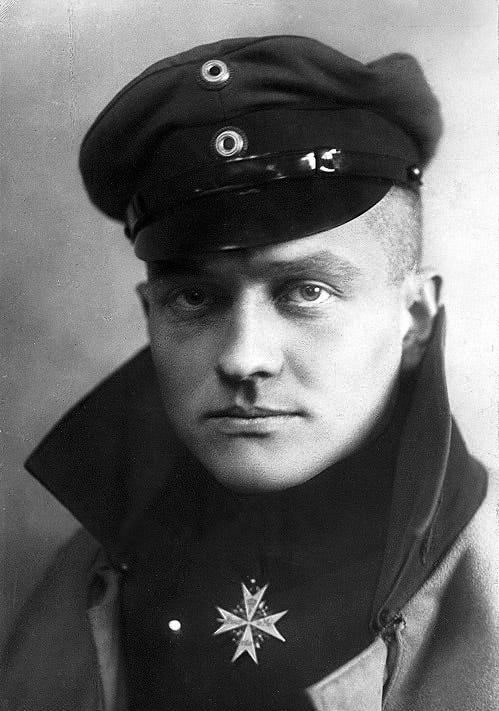
Baron Manfred Albrecht von Richthofen was born in 1892 in Germany, but in an area that is now part of Poland. He attended a military school and went into a cavalry unit, the kind with actual horses and lances as weapons, at 17. In 1914, when war broke out, he served as a reconnaissance officer in Russia, France, and Belgium, until the fighting bogged down into the trench warfare that characterized that conflict. With no need for cavalry, he was assigned to be a supply officer, a fate worse than death to him.
He immediately applied for and received a transfer to the flying service, starting as an aerial observer, then pilot. He claimed two aircraft shot down during this period, but did not receive confirmation for either. Finally, in 1916, he was selected to join one of the first fighter squadrons.
Airplanes were still very new at that time. The first flight had only been in 1903, and the military uses of aircraft were still being worked out. They were initially used only for bombing and gathering intelligence on enemy troop movements. But things were progressing rapidly. The battle in the skies had gone from shooting at one another with pistols and shotguns to twin machineguns with a synchronization gear so that the pilot did not shoot off his own propeller.
The aircraft were made of thin cloth, lacquered and stretched over wooden frames, held together with screws and wire. There was no armor for the pilots. The gas tanks were simple metal cans, easily penetrated and set afire by gunfire. And there were no parachutes until very late in the war. Indeed, the American higher-ups were reluctant to issue parachutes, fearing that the pilots would bail out at the first hint of trouble.
You may think that anyone who would go up and fight under those conditions would be slightly insane.
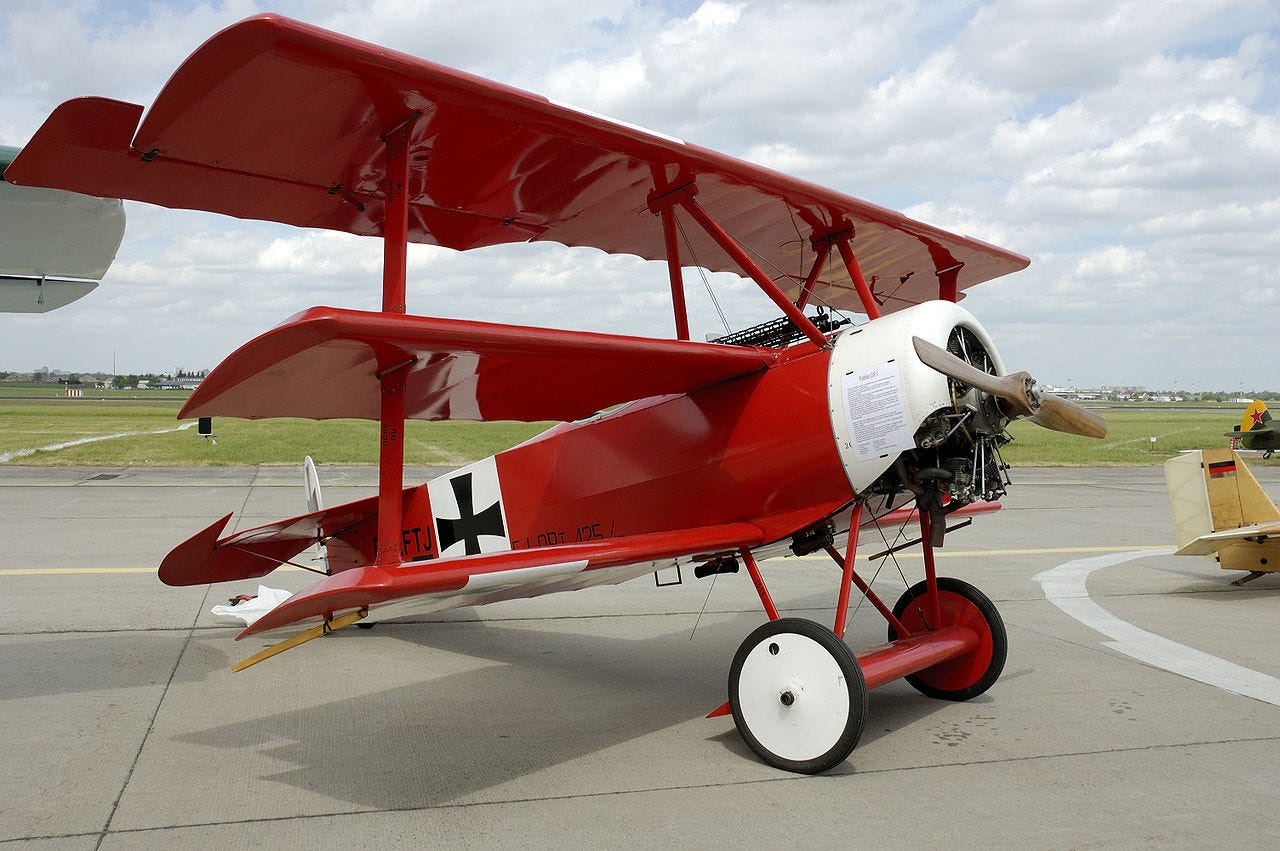
Be that as it may, Richtofen excelled as a fighter pilot. His actual tally might have been over 100, but he officially shot down 80 enemy aircraft. Of course, as a German, his enemy consisted of the British, Canadians, French, Americans, and Belgians. He assumed command of Fighter Squadron 11 in early 1917 and took the unusual step of having his aircraft painted a bright red. This was a threat, a taunt, a challenge to his opponents. He wasn’t trying to hide behind camouflage. Quite the opposite!
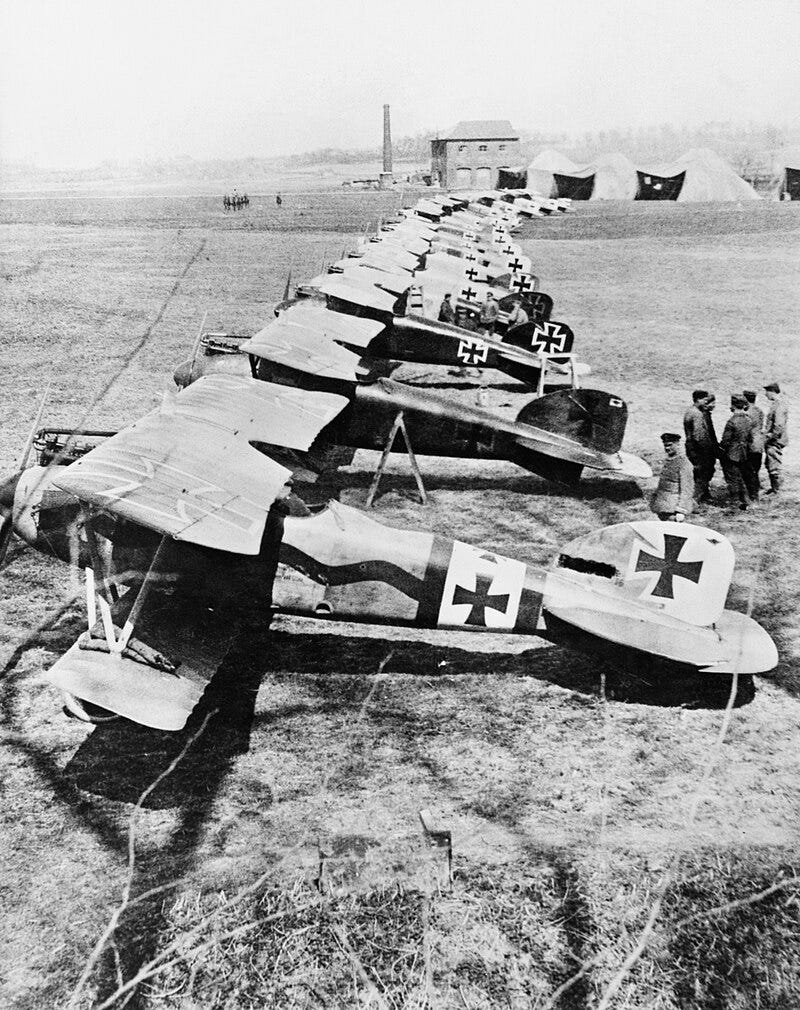
The other pilots soon took after their leader, splashing their aircraft in garish colors, and the squadron became known as “The Flying Circus”. But it was not a circus that one wanted to see. In one month, Bloody April of 1917, the British lost 245 aircraft vs. the German’s 66. Richtofen’s unit scored 89 of those victories, and he personally shot down 22. It should also be noted that the Germans were not only outnumbered, but that their aircraft were, overall, inferior.
Despite all of that, the Baron’s reputation grew, and he and his squadron became a source of fear, taunting their opponents every time they flew. He gained the name that we still know today, over a century later. Whether the name came from the color of his aircraft or the blood that he spilled remains a question.
But the bloody Red Baron would only live for another year. His aircraft crash-landed in a sector defended by Australians on the morning of April 21, 1918, and he was found dead in the cockpit. He was given a full military funeral befitting his rank and stature, including an honor guard, a rifle salute, and memorial wreaths from nearby squadrons, one inscribed “To Our Gallant and Worthy Foe”.
Propaganda attributed the victory to a Canadian pilot, Captain Roy Brown, but there continues to be controversy. For one, Brown fired only briefly at the Red Baron and he never claimed that he had shot him down. Indeed, he was never in a position to have inflicted the wound, which went from side to side, starting low and angling upwards through the lungs. The only men with the opportunity for such a shot would have been antiaircraft gunners on the ground. Which particular one remains a mystery, despite a huge amount of research from a number of people and institutions, including the British Channel 4 Secret History series, Nova, and the Discovery Channel.
Baron von Richtofen died less than two weeks short of his 26th birthday, which would have been on May 2nd. I have to think it’s a fortunate thing that he didn’t survive to be contaminated by the Third Reich and remained a gallant knight of the air, so to speak.
A number of Luftwaffe squadrons were named after Richtofen during World War II and the postwar German Tactical Air Force Wing 71 still names him as their patron. The U.S. Air Force’s Red Flag training exercise is an outgrowth of Project Red Baron. The list of references to him in modern culture is extensive, from fiction to board games, video games, movies, musicals, songs, plants, a building, an airport, a custom car, and sports teams and figures.
Al Hagan’s third book in the post-apocalyptic Hexen series, The Bloody Princess, is on Amazon: https://amzn.to/41XjA57
Here’s Adam Savage (Mythbusters) and Peter Jackson (filmmaker) playing laser tag with WWI aircraft:
Sabaton’s song ‘The Red Baron’: